August 2, 2026
Nike Air Rift Sizing: Go Up 1–1.5cm. Here's Why, From Someone on Her 9th Pair
- Nike Air Rift
- sizing guide
- split toe
- tabi sneakers
- Nike
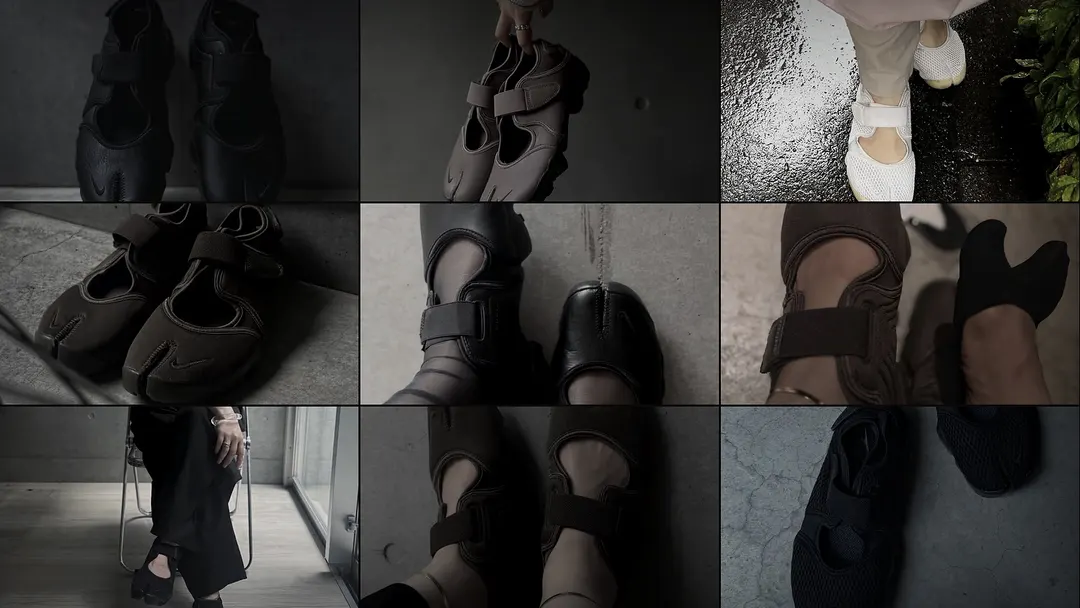
WHAT YOU'LL LEARN
- I wear 24.5cm in pumps and 26cm in the Air Rift — that is 1.5cm up
- The toe split, not the length, is what makes your usual size feel tight
- The odd split-toe feeling takes about 2–3 days to disappear
- US, EU and CM conversion table so you can order in the right size
- What forwarding from Japan actually costs, by country
Short answer: go up 1 to 1.5cm from your usual sneaker size.
I have worn the Nike Air Rift for 10 years and I am on my 9th pair — four of them bought this year alone. I also used to work in the planning department of a shoe manufacturer in Japan, so I have opinions about lasts and toe boxes that I did not ask for.
Every time I post about these shoes, the same question arrives: what size should I get? So here is the answer, with the reasoning.
The short answer, with numbers
Here is my own sizing, which is the most useful thing I can give you:
- Pumps / dress shoes: 24.5cm
- Nike Air Rift: 26cm
- New Balance: 25cm
- Converse (men's): 25cm
- Asics: 25.5cm
So the Air Rift is 1.5cm larger than my dress shoe size, and 1cm larger than my usual sneaker size.
I tried 25cm. It was not too short. It was tight between the toes — and that is a completely different problem, which I will explain next.
If you have wide feet or bunions, give yourself even more room than I did.
Why the usual size does not work
The Air Rift has a split toe: your big toe goes into its own pocket, like a Japanese tabi sock.
That construction changes what "fits" means. On a normal sneaker, you judge length. Here, the seam that separates the big toe sits against the web of skin between your first and second toe. If the shoe is even slightly short, that seam presses into that gap.
From my time in shoe planning: forcing this fit does not "break in" the way a tight leather shoe eventually gives. The skin between your toes gets sore instead. That is the failure mode to avoid, and it is why I tell people to start with room rather than hope.
How to choose
Order your normal sneaker size
→ the toe seam digs into the web between your toes
Order 1–1.5cm up
→ the split sits comfortably and the shoe still holds your foot
Size conversion: CM, US and EU
Japanese sizing is in centimetres, which is what I use above. If you order outside Japan, here is how those numbers translate on Nike's own women's chart.
| My dress shoe size | 24.5cm = US W7.5 = EU 38.5 |
| What I tried and rejected | 25cm = US W8 = EU 39 (tight at the toe split) |
| What I actually wear | 26cm = US W9 = EU 40.5 |
| Rule of thumb | 1–1.5cm up = about 2 to 3 US half-sizes up |
| If you have wide feet | Add more room, not less |
One caution: the CM figure printed on a Nike box is the brand's size label, not a measurement of your foot. Use your known size in another Nike shoe as the anchor if you have one, rather than measuring your foot and hoping.
The split-toe feeling: 2–3 days
The first time I put them on, my honest reaction was "oh, that's strange." Having one toe separated feels nothing like a normal sneaker.
It takes about two or three days of wear for that to disappear completely. After that, I actually enjoy it — there is a feeling of the toes being free that regular sneakers do not give you.
I mention this because a lot of people try the shoe once in a store, feel the strangeness, and decide it is not for them. That is a shame. The strangeness is temporary. A shoe that is too small is not.
Why I keep buying them
Nine pairs is not loyalty to a look. It is the sole.
The Air unit under this shoe is genuinely good. I have walked 10,000 steps in a day while travelling and my feet were fine — that was the moment I decided I would keep buying them.
A few other things that keep them in rotation:
- The opening is wide and the upper is soft, so they go on and off like sandals
- The silhouette is slim — no chunky platform, no loud logo
- Materials vary a lot: mesh for summer, leather, and a neoprene-type model
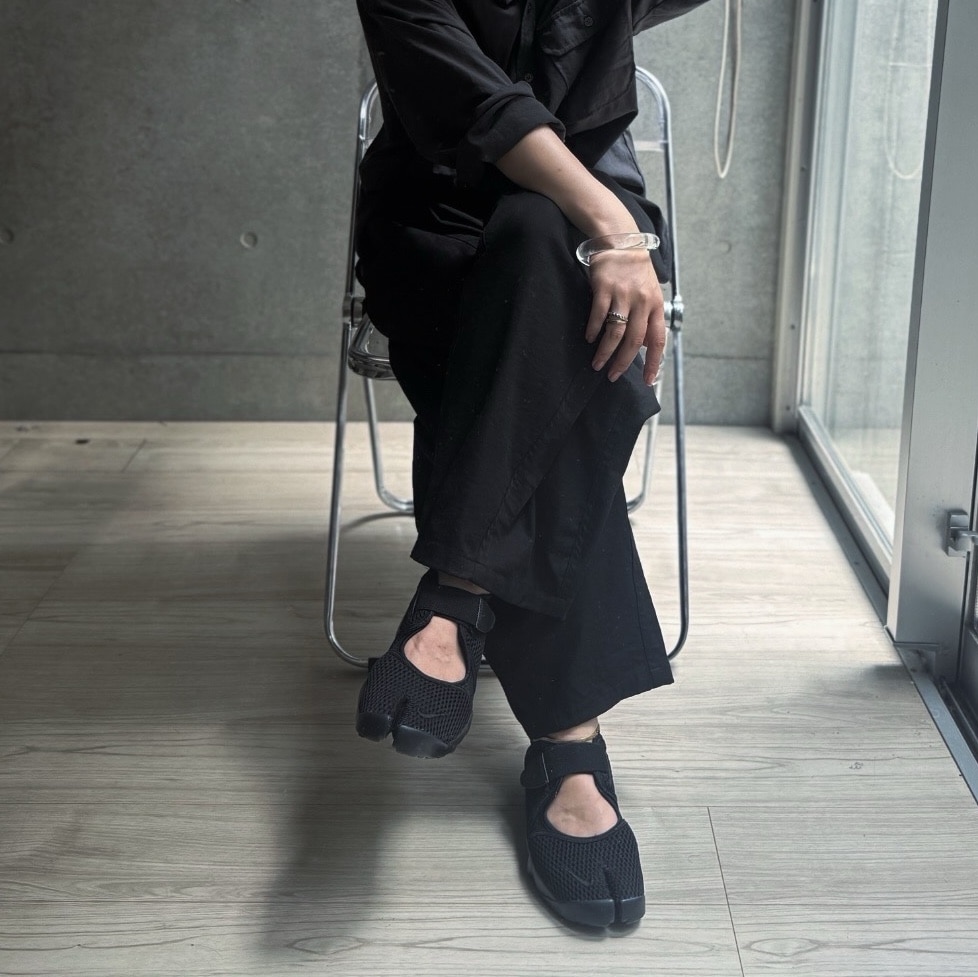
- Models where the sole matches the upper (all-black mesh, or the darker neutral colourways) read more like shoes than sneakers, which is why they work for grown-up outfits
That last point matters if you are past your twenties and worried the split toe is too much of a statement. Pick a colour where the sole does not contrast, and it calms down considerably.
Buying from Japan, and what shipping actually costs
I buy mine on Rakuten in Japan, and the listing below is the one I use.
If you live in Japan, this is straightforward — domestic shipping, and Japanese sizing in CM matches the chart above.
If you are outside Japan, Rakuten has an official forwarding service (Rakuten Global Express) that receives your order at a warehouse in Japan and ships it on. Whether that is worth it depends almost entirely on where you live. Here is what it costs as of August 2026:
| Hong Kong | ¥1,790 for 500g / ¥4,500 for 2kg |
| Singapore | ¥2,330 for 500g / ¥4,700 for 2kg |
| Taiwan | ¥2,390 for 500g / ¥5,220 for 2kg |
| United Kingdom | ¥4,200 for 500g / ¥6,240 for 2kg |
| United States | Effectively closed — see below |
The one thing that changes the maths: consolidation is free. You can have several orders from different shops held at the warehouse and sent as one package at no extra handling charge. A single pair of sneakers is a poor use of an international shipment. A 2kg box with a few things in it is a reasonable one.
For the UK and Singapore there is a further convenience: for orders under £135 (UK) or S$400 (Singapore), the tax is collected up front and handled on your behalf, so nothing unexpected arrives at your door.
The exception is the United States. Standard Express and sea freight are unavailable for packages with a total merchandise value under ¥410,000 (about US$2,500), and Economy Air is not offered at all. That leaves courier service only, which is not sensible for a pair of sneakers. If you are in the US, buy the Air Rift locally — the sizing advice above is the part worth taking with you.
FAQ
How much should I size up in the Air Rift?
One to 1.5cm above your usual size. For me that is 24.5cm in dress shoes to 26cm in the Air Rift. In US women's sizing that is roughly two to three half-sizes up.
Does the split toe hurt?
Not if the shoe fits. It feels strange for the first two or three days, then stops registering. It only hurts if you sized down, because the toe seam then presses into the skin between your toes.
Are they comfortable for walking all day?
Yes. The Air sole is the reason I own nine pairs. 10,000 steps in a day while travelling left my feet fine.
Mesh or leather?
Mesh is the easier first pair: lighter, better in summer, and the all-black mesh version is the most versatile. Leather is a nicer object and ages well, but it is warmer.
Do they work if you are over 40?
I am, and I have worn them for a decade. Choose a colourway where the sole matches the upper and they read as shoes rather than sneakers, which is what makes them work with adult clothing.
Is it worth buying from Japan?
It depends where you live. From Hong Kong, Singapore or Taiwan, forwarding costs roughly ¥1,800–5,200 depending on weight, and consolidation is free — so it makes sense if you are buying a few things at once. The UK is workable at ¥4,200–6,240 with tax handled up front. The United States is the exception: standard shipping methods require a package worth over ¥410,000, so buying locally is the better call there.